Ab Lofthus
The SonAb Lofthus is Sonny’s father and a police officer remembered as one of the toughest in Oslo. His apparent confession to being a criminal informant conceals a more complicated truth: he had been drawn into corruption by Simon, then was framed as the police mole and killed. The revelations surrounding his life and death reshape Sonny’s understanding of his father, while exposing the debts, divided loyalties, and betrayals that helped corrupt the police force.
Identity and family
Ab was a police officer whose son, Sonny, admired him and wanted to follow in his footsteps. A teacher later recalled Sonny as a gifted pupil and wrestler who hoped to become a policeman like his father. After Ab was found dead beside a note confessing to corruption, Sonny stopped attending school and began to withdraw from the life he had led before his father’s death.
Ab and Helene had a son and made a home together, but their finances became precarious. Ab’s diary records that he was glad Sonny had taken up wrestling and that the boy seemed unaware of his parents’ difficulties. As mortgage payments became harder to meet, Ab wrote of needing to think of something before the house was repossessed. The diary connects that pressure to the choices that followed, giving his family’s financial insecurity a central place in the story of his betrayal.
Ab had grown up among close friends who shared a flat in Oslo while attending the Police College. The three men called themselves the troika: Ab, Simon Kefas, and Pontius Parr. Helene joined their household as a lodger, and all three men fell in love with her. She chose Simon first, but the relationship did not last; after Simon’s gambling debts destabilized their life together, Ab and Helene moved out, and she later became Ab’s partner and Sonny’s mother.
From officer to mole
Simon’s gambling losses and heartbreak led him to approach the Twin and offer his soul in exchange for help. When Ab and Helene were deeply in debt during the banking crisis, Simon brought Ab into the arrangement as well. Ab initially refused and threatened to report Simon, but Simon argued that Sonny would suffer for his father’s pride and poverty. Ab accepted the offer, and his diary describes the resulting corruption: he and Simon turned a blind eye to drug dealing, human trafficking, and murder.
The diary reveals that the arrangement depended on two compromised officers, not one. Ab writes that the Twin believed he was dealing with a single informant, while the two police officers maintained separate identities and communications. Their anonymous exchanges included messages passed through email and physical drops. When the Twin appeared to favor advancing one of them inside the police force, Ab and Simon began to distrust each other; each understood that the arrangement might leave only one of them useful and the other exposed.
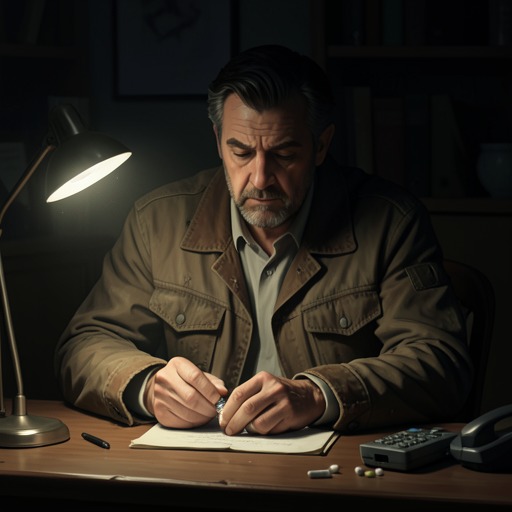
Ab’s diary places the final break in Maridalen. He arranged for Helene to take Sonny to a wrestling competition and asked Simon to meet him at the medieval ruins. On the eve of the meeting, Ab recorded that he had loaded his pistol and wondered whether he acted for his family, for himself, or from ambition. He anticipated that he might return as a changed man, a killer. The diary’s torn-out final pages leave the immediate details of the encounter incomplete, but later accounts establish that Ab died that night.
Death and the false confession
Sonny and Helene were away at a wrestling competition in Lillehammer when Ab was killed. He had told them he needed to stay home because he had something important to do. When they returned, Sonny found his father dead in his study. Sonny later told Martha that he had signed a suicide note to save his mother and himself. He had found the note after discovering Ab’s body and handed it to the police, believing that the confession it contained implicated his father in corruption.
Johannes Halden later explained that the note did not tell the truth. Johannes had overheard Hugo Nestor speaking about the need to get rid of a policeman named Lofthus, warned Ab that he was in danger, and kept silent because Ab had asked him to protect the family from involvement. Ab believed other police officers were compromised and said he had to act alone. Nestor and his men entered the house despite Ab’s efforts to barricade it. They forced him to write the note so that his death would appear to be suicide and the police would stop searching for the real mole; they then killed him with his own gun. The confession was therefore both a false accusation against Ab and a means of protecting the criminal network.
The Twin later confirmed that the plan had been to make Ab’s death look like suicide and to use the note to persuade the police that Ab had been the mole. According to the Twin, the actual informant had warned him that Ab planned to kill him at the ruins and that the police were closing in. The Twin said that he agreed to the killing to protect his mole, though he claimed not to know the informant’s identity. These accounts clarify that Ab’s apparent confession was forced, while also showing that his own participation in the Twin’s operation had made him vulnerable to the final betrayal.
Sonny’s inheritance and the investigation
For years, the police treated Ab’s death and the confession as proof that he had been the mole: once he was dead, failed raids and missing evidence ceased, which seemed to confirm the conclusion. Simon challenged that inference. Ab had been proud of his work and the police force, Simon said, and had cared more about his family than making money; nonetheless, Simon insisted that a real mole existed. The cessation of leaks after Ab’s death was not proof that Ab had been the source.
Sonny grew up under the shadow of the confession. His father’s apparent disgrace helped turn the boy away from school and toward self-destruction; later, Sonny became a killer. When Simon identified him as Ab’s son, he named the contrast between the respected policeman and the criminal his son had become. Other characters also understand Sonny’s violence as an attempt to carry out what he believes his father stood for: justice beyond a corrupt legal system. The mistaken public story about Ab thus shapes Sonny’s grief and his sense of duty even while obscuring the facts of his father’s life.
The novel ultimately makes Ab neither the spotless hero suggested by Sonny’s childhood admiration nor the simple traitor described by the suicide note. He did enter the Twin’s criminal arrangement, under pressure shaped by Simon’s manipulation and his family’s debts; he also recognized the danger, tried to confront it, and was killed before he could expose the corruption. His diary supplies the motive and sequence behind his fall, while the later testimonies expose the false confession. Through Ab, the story connects private financial desperation to institutional betrayal and shows how a hidden truth can govern a son’s life long after the father who knew it is gone.